The Goldsmith Lab
  • Home
  • People
  • Ecology & Education
  • Publications
  • Thoughts

A Place For Occasional Thoughts

-------------------------------------------------------------------------------

Handling Editors and Thank You Notes

7/20/2015

0 Comments

 
In the past 12 months, I have been asked by editors from 18 different journals to peer review 22 different manuscripts. This is clearly not sustainable. 

I recognize that I am not alone in this experience and I offer no great solutions; my approach has been to review a manuscript for every manuscript that I author or co-author.

However, beginning with the article we published last year in Ecosphere, I have adopted one new habit. I am writing and mailing a thank you note to every handling editor that I work with, regardless of their decision. If I receive 22 manuscripts a year, I can only imagine the thankless job of an editor. 

0 Comments

The linkages between photosynthesis, productivity, growth and biomass in lowland Amazonian forests

1/12/2015

0 Comments

 
I am a co-author on a new paper that is in press at Global Change Biology. The paper explores how landscape level patterns in precipitation and soil drive differences in the carbon cycle of lowland Amazon forests. I'll write more on this soon, but in the interim, you can check out the layperson's abstract and access the full text through the link at the bottom: 

Understanding the relationship between photosynthesis, net primary productivity and growth in forest ecosystems is key to understanding how these ecosystems will respond to global anthropogenic change, yet the linkages among these components are rarely explored in detail. We provide the first comprehensive description of the productivity, respiration and carbon allocation of contrasting lowland Amazonian forests spanning gradients in seasonal water deficit and soil fertility. Using the largest dataset assembled to date, ten sites in three countries all studied with a standardized methodology, we find that (i) gross primary productivity (GPP) has a simple relationship with seasonal water deficit, but that (ii) site-to-site variations in GPP have little power in explaining site-to-site spatial variations in net primary productivity (NPP) or growth because of concomitant changes in carbon use efficiency (CUE), and conversely, the woody growth rate of a tropical forest is a very poor proxy for its productivity. Instead, (iii) spatial patterns of biomass are much more driven by patterns of residence times (i.e. tree mortality rates) than by spatial variation in productivity or tree growth. Current theory and models of tropical forest carbon cycling under projected scenarios of global atmospheric change can benefit from advancing beyond a focus on GPP. By improving our understanding of poorly understood processes such as CUE, NPP allocation and biomass turnover times, we can provide more complete and mechanistic approaches to linking climate and tropical forest carbon cycling.


Malhi, Y. C.E. Doughty, G.R. Goldsmith, D.B. Metcalfe, C.A.J. Girardin, T.R. Marthews, J. del Aguila-Pasquel, L.E.O.C. Aragão, A. Araujo-Murakami, P. Brando, A.C.L. da Costa, J.E. Silva-Espejo, F.F. Amézquita, D.R. Galbraith, C.A. Quesada, W. Rocha, N. Salinas-Revilla, D. Silvério, P. Meir & O.L. Phillips. 2015. The linkages between photosynthesis, productivity, growth and biomass in lowland Amazonian forests. Global Change Biology DOI: 10.1111/gcb.12859


0 Comments

Science Magazine Editor's Choice

12/19/2014

0 Comments

 
Picture
Our recent article in Ecosphere, which considers how we evaluate and assess the efficacy of web-based educational outreach, is highlighted as an editor's choice in Science Magazine. As they note in the article, using our approaches to understanding website users and their behavior can help us to "better allocate resources....making online science education efforts more targeted and efficient." 

0 Comments

National Geographic Student Expeditions in Costa Rica

11/19/2014

1 Comment


I am excited to be joining National Geographic Student Expeditions as one of their guest experts for their expedition to Costa Rica next summer. I had the opportunity to work with their students a few years ago for an afternoon planting trees and it was a blast. I am looking forward to spending a week looking for the weird and wild with them in my old stomping grounds, the cloud forests of Monteverde. 


1 Comment

Improving the efficacy of web-based educational outreach in ecology

10/30/2014

1 Comment

 
Picture
There is a growing movement towards using the web for educational outreach in the sciences. The unfortunate truth is that no one really knows whether or not it is working.

We have a new paper out this week  in the journal Ecosphere, the open access journal of the Ecological Society of America. I have contributed a guest post to their blog Ecotone, describing what we have done in greater detail. 

If you want to go straight to the source, you can access the paper from ESA here: 

Goldsmith, G.R., A.D. Fulton, C.D. Witherill, & J.F. Espeleta. 2014. Improving the efficacy of web-based educational outreach in ecology. Ecosphere 5: 131.

The core data underlying the paper is published in the Dryad Digital Data Repository, which is also open access and can be accessed here: Goldsmith, G.R., A.D. Fulton, C.D. Witherill, & J.F. Espeleta. 2014. Data from: Improving the efficacy of web-based educational outreach in ecology. Dryad Digital Data Repository.


1 Comment

Before the Kardashian Index

10/16/2014

1 Comment


Science recently published a letter I wrote to the editor regarding an article on social media as a means of outreach. For those interested in the origins of this unusual happening, please see Neil Hall's paper describing the Kardashian Index in the journal Genome Biology. Irrespective of what you think of this debate, my letter is an attempt to ask two simple questions about the scientific community's use of social media for public engagement: 


1) Does it work? 
2) If so, could we be using it more effectively? 


Answering these questions objectively requires data. My recent collaboration with Drew Fulton, Colin Witherill and Javier Espeleta exploring the efficacy of Twitter and Facebook in driving visitors to our website Canopy in the Clouds revealed to me that, for the most part, we have no data. Let's raise the bar...


**Original post on 17 October, edited with additional information on the 21st and 29th of October.


1 Comment

Tropical Forests in the Anthropocene

9/17/2014

0 Comments

 
I had a great experience recently collaborating with my post-doctoral advisor, Yadvinder Malhi, as well as Toby Gardner, Miles Silman and Przemek Zelazowski on a new review paper considering the effects of the Anthropocene on tropical forests. I will not go into the details of the review, other than to say that the primary focus is in identifying and exploring what human activities we expect to be the most critical for the future of tropical forest functioning. The paper is now available at the Annual Review of Environment and Resources.  

As part of the paper, we consider what research has been done on anthropogenic impacts in tropical forests and where that research has been done. In fact, we studied a subset of the entire peer-reviewed literature carried out in tropical forests for the last five years. Here's what we came up with: 

Picture
The size of the circle indicates the number of studies carried out at the location. The big circle with all those studies is Smithsonian's Barro Colorado Island Research Station in Panama; the big embedded circle within it is the Organization for Tropical Studies' La Selva Biological Station in Costa Rica. The number of research studies carried out there dwarfs any other place in the Tropics. 

On the whole, the takeaway message is that there is a disproportionate amount of research in Mesoamerica relative to its size.

 While many of us may be cognizant of this geographic bias, there has been no systematic effort (that I am aware of) to correct it. The advantages of research station infrastructure are obvious, as are the disadvantages of a knowledge base focused on such a small proportion of the Tropics. As a community, it may be time for a strategic plan for the future of tropical science. In the absence of such an approach, I fear that we'll never truly understand the impacts of the Anthropocene. 

A high resolution version of the figure, the figure legend, and the underlying data are freely available. Of course, do read the paper for all the interpretation....and please send me an email if you have thoughts. 
0 Comments

Goodbye @Impactstory - My #altmetrics Will Come From Elsewhere

8/29/2014

1 Comment

 
I strongly support moving towards more integrative methods for measuring the impact of scientific research. Historically, the measure of success has been simply counting the number of times a research article was cited by other research articles. While interesting, there has been a very interesting and promising movement towards "altmetrics," which tries to take a more inclusive approach to how research is consumed by both academic and non-academic communities.  

One of the most promising aggregators for altmetrics has been Impactstory, a non-profit initiated in 2011. Until today, I maintained my Impactstory profile on this website with my list of publications. But in a series of blog posts in July and August, Impactstory announced that they would begin charging for their services. 

By monetizing their services, Impactstory forced me to assess whether I thought I would experience sufficient return for my investment. At present, there is no evidence that people value my work more (i.e. will hire me) because I use Impactstory. However, I do want to support the growth of altmetrics and its long-term success. 

So, my publications page is now going to use the free altmetrics badges from "the competition" over at Altmetric.com. Even for those of us scientists who are not incredibly savvy to programming (this site is built on Weebly), adding the badges is incredibly simple following the instructions available on their website.

Ultimately, Altmetric.com, which won Elsevier's apps for science contest in 2011, appears to be pursuing a different business model. Rather than placing the cost of development on scientists, they are placing it on scientific publishers. While  Altmetric.com is for profit and Impactstory is non-profit, both are ultimately  businesses; I hope Impactstory's business model works...
1 Comment

Evidence of a Life Well Spent

7/15/2014

1 Comment

 
Picture
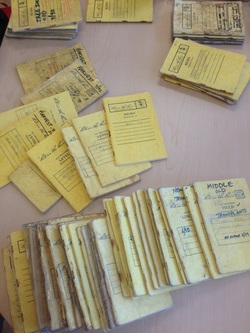
I am privileged to be visiting with Nalini Nadkarni this week at the University of Utah. Nalini has an incredibly distinguished career in both science and science communication. One need look no further than this pile of field research notebooks to understand that she has truly dedicated her life to understanding the ecology of tropical montane cloud forests. For me, opening these old books has brought nothing but new ideas for research. That we are doing new science- based on data collected over 25 years ago -speaks to just how meticulous Nalini was in the field. If I have learned nothing from this week, it is how incredibly valuable it can be to spend just a few extra minutes at the end of the day writing those seemingly obvious details down...you never know who will be reading it in the future. 

1 Comment

Google as a Tool for Understanding Science Communication

5/20/2014

1 Comment

 
Picture
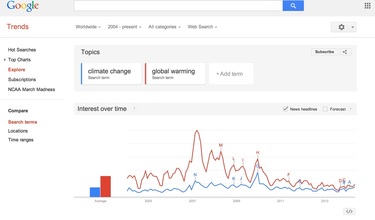
A few years ago, the servers in the Climate Research Unit at East Anglia University were hacked and thousands of emails from the climate scientists working there were copied. The emails were anonymously uploaded onto various servers and subsequently delivered to the media. The timing was coincident with a major climate change policy meeting (the 2009 United Nations Climate Change Summit in Copenhagen) and portions of text form the emails were selected so as to make it appear that the scientists were engaging in scientific misconduct. The story quickly gained traction in the international media. Multiple different independent investigations found no evidence for misconduct on the part of the scientists whose emails had been illegally accessed, but this process took many months. How do we study the interest in, and impact of, such events on the public's perception of climate science? 

My colleague Bill Anderegg and I have been using Google Trends to try to make sense of events and trends in climate science communication. The result is a new (open access) paper in the journal Environmental Research Letters. Effectively, Google Trends allows us to look at how the number of searches in Google for climate change related queries varies across space and time. A couple of ideas to take away from our results:

1) Public interest in climate change, as measured by the volume of searches for the issue, has decreased significantly since a peak in 2007. The evidence for serious anthropogenic climate change has only gotten worse during this time. 

2) The public searches for "global warming," not the more comprehensive "climate change." As a community, we need to use the search terms that are being engaged by the public.

3) Major climate communication events, positive or negative, generally have a very short half-life in the media. A few days at best. 

4) Google Trends is the harbinger of a new era for the study of effective science communication, in that it can provide open access to historical and real time information on public interest in a topic. It's a great complement to traditional survey methods. 

Ultimately, my hope is that our research serves as an example of how Google Trends can help improve the dialogue around climate change by providing insight into what the public is searching for information about, where they are, and when they are searching. 

Anderegg, W.L. and G.R. Goldsmith 2014. Public interest in climate change over the past decade and the effects of the 'climategate' media event. Environmental Research Letters 9, 054005.


1 Comment
<<Previous
Forward>>

    Archives

    May 2026
    August 2025
    June 2025
    January 2025
    November 2024
    October 2024
    July 2024
    November 2023
    August 2023
    May 2023
    February 2023
    September 2022
    July 2022
    April 2022
    March 2022
    August 2021
    May 2021
    February 2021
    December 2020
    August 2020
    July 2019
    March 2019
    November 2018
    March 2018
    January 2018
    November 2016
    October 2016
    September 2016
    June 2016
    May 2016
    April 2016
    February 2016
    January 2016
    August 2015
    July 2015
    January 2015
    December 2014
    November 2014
    October 2014
    September 2014
    August 2014
    July 2014
    May 2014
    March 2014
    February 2014
    November 2013
    September 2013
    August 2013
    July 2013

    Categories

    All
    Altmetrics
    Amazon
    Clean Water
    Conservation
    Deforestation
    Ecohydrology
    Google Trends
    Meteorology
    Plant Ecophysiology
    Science Communication
    Smartphones
    Stable Isotopes
    Technology And Innovation
    Tropical Ecology

    RSS Feed

Powered by Create your own unique website with customizable templates.